
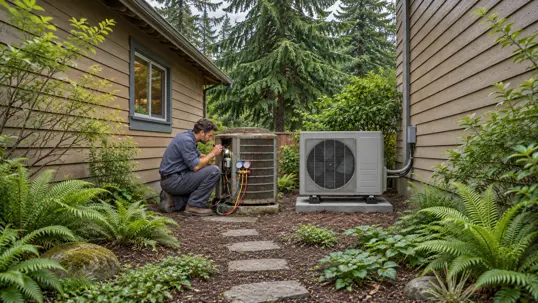
Your heating or cooling system is getting older, and now it needs a repair. Should you fix it and keep going, or put that money toward replacement?
Here’s the short answer:
- Repair often makes sense when the problem is isolated, the equipment is otherwise in good condition, and the cost is reasonable after warranty coverage.
- Replacement deserves a closer look when an aging system needs major work, breaks down repeatedly, or can no longer keep your home comfortable.
For Eugene homeowners, the decision can also involve adding air conditioning. If your home currently relies on a furnace or electric resistance heating, a heat pump could address both heating and cooling when replacement becomes necessary.
This guide explains how system age, repair costs, and warranty coverage affect the decision, what a diagnostic visit should establish, and when replacement is worth considering. We’ll also cover heat-pump options and local incentives that can change the comparison for Eugene homes.
Repair or Replace? A Quick Comparison
Symptoms tell you that something needs attention. The diagnosis determines whether repairing the equipment is a sensible investment.
| What you’re dealing with | When repair deserves consideration | When to compare replacement |
|---|---|---|
| A system under 10 years old stops working | One failed component, available parts, and otherwise sound equipment | Major damage, repeated failures, or a documented installation problem that is expensive to correct |
| An older system needs its first repair in years | A manageable repair with no broader condition or safety concerns | Major component failure combined with substantial wear |
| Several service calls within the past two years | The cause is identified and can be corrected | Different components keep failing and reliability is declining |
| Uneven temperatures or weak airflow | Filter, duct, blower, or control problems can be corrected | Equipment is improperly sized or cannot meet the home’s needs after other issues are addressed |
| A compressor or heat exchanger fails | Warranty coverage and the condition of the remaining equipment support component replacement | The equipment is older, out of warranty, and needs other significant work |
| Heating works, but the home has no cooling | Keeping the heater and adding cooling is practical | A heat pump could meet both needs as part of a planned replacement |
How System Age Affects the Repair-or-Replace Decision
A repair might be worth making at eight years old, but much harder to justify at eighteen. Age helps you weigh how much useful life the equipment may have left, especially when the repair is expensive.
Typical service-life ranges are:
| Equipment | Common Service-Life Range |
|---|---|
| Furnace | 15–20 years |
| Central Air Conditioner | 10–15 years |
| Heat Pump | 10–15 years |
Installation quality, maintenance, and operating conditions affect how long equipment lasts. These ranges help frame the decision; they cannot tell you how many years your particular system has left.
When Should You Start Comparing Replacement?
ENERGY STAR recommends considering replacement options once an air conditioner or heat pump is more than 10 years old, or a furnace is more than 15 years old. Frequent repairs or declining performance make that comparison more relevant.
Once your system reaches these ages, weigh the cost of repairs against its overall condition and expected remaining life. If it has been reliable and the repair is reasonably priced, keeping it running can still make financial sense. But if it needs an expensive repair, has broken down repeatedly, or has other major components showing significant wear, replacement may be the better long-term investment.
Look Beyond the Failed Part
Two systems of the same age can have very different amounts of wear. A diagnostic assessment helps establish whether the failed component is an isolated problem or part of broader deterioration. That distinction gives a repair estimate more meaning than equipment age alone.
What a Diagnostic Should Establish
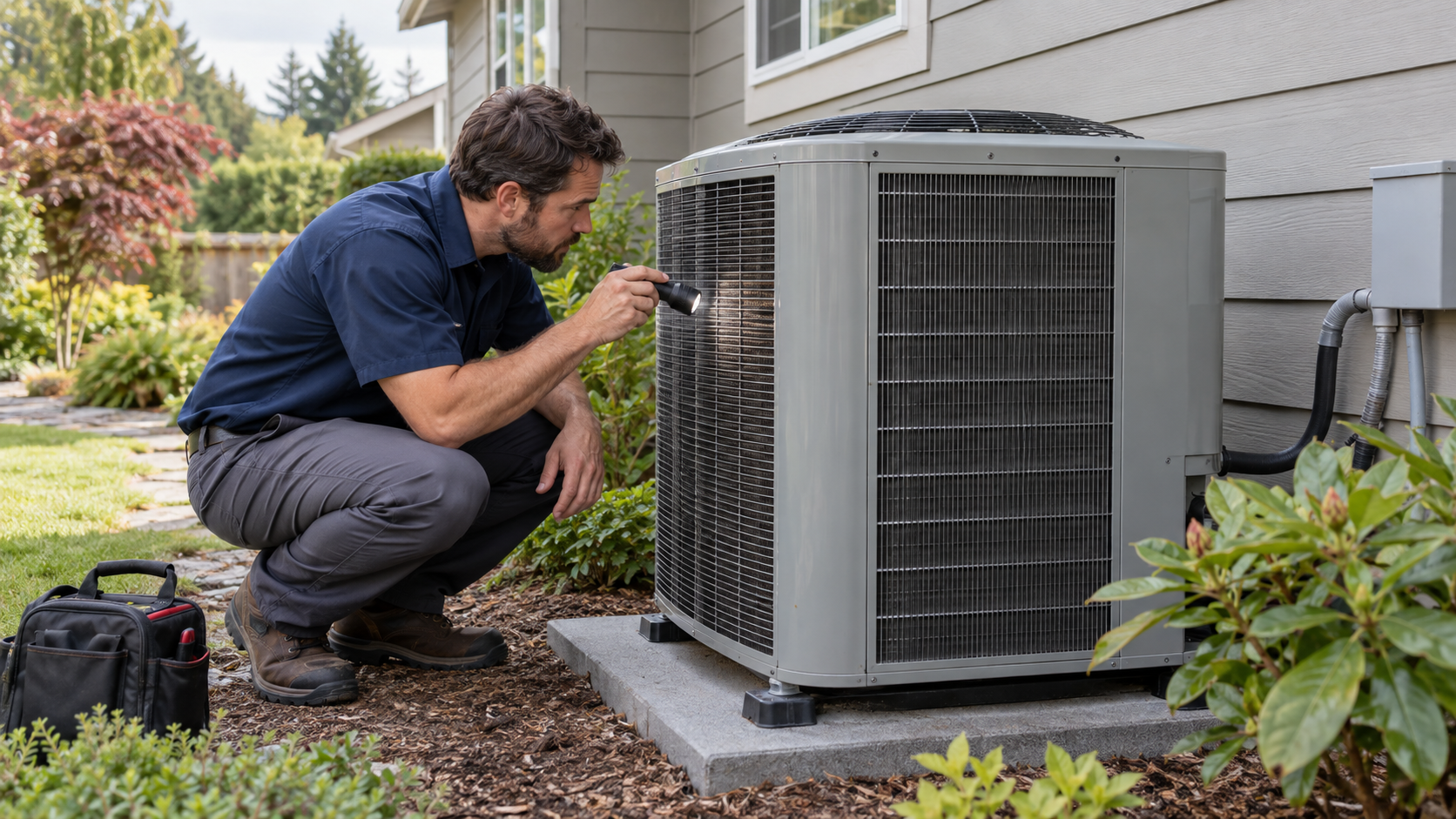
Before comparing repair and replacement, you need to know what failed and why. The checks depend on your equipment and symptoms. A useful assessment should address:
- The reported problem: When it happens, whether it affects heating or cooling, and any error codes or unusual sounds.
- Airflow and controls: Filter condition, thermostat operation, blower performance, and relevant duct restrictions.
- Equipment operation: Electrical components, refrigerant performance where applicable, and furnace ignition and safety controls.
- Overall condition: Other worn components, repair history, and applicable warranty coverage.
At Associated Heating & Air Conditioning, our technicians inspect the equipment, explain their findings and recommended work, and review costs before repairs begin. After the repair, system testing helps confirm that the problem has been addressed.
Need help understanding a repair recommendation? Request an appointment with Associated Heating & Air Conditioning to have your system evaluated.
When Repair Is a Reasonable Investment
Repair often makes financial sense when a single failed component causes the breakdown and the rest of the system remains in good condition. A reliable maintenance history, consistent comfort, and reasonable operating costs strengthen the case for keeping the equipment.
Even an older system can be worth repairing. An affordable fix that restores dependable heating or cooling can extend its useful life and give you time to budget for replacement. The value is less certain when the repair addresses only one of several developing problems, leaving other worn components likely to cause another breakdown.
Warranty coverage can also change the calculation. A covered part may reduce the repair cost enough to make keeping an otherwise sound system worthwhile, although labor and other service charges may still apply.
Associated provides furnace repair, air conditioning repair, and heat pump repair in the Eugene area.
When Replacement Deserves a Serious Comparison
Sometimes the question goes beyond whether a system can be repaired. The available repair may involve difficult-to-source parts, a lengthy interruption in service, or work that still leaves the home without dependable heating or cooling.
Replacement Parts Are Difficult to Obtain
A repair depends on having the correct components available. For older or discontinued equipment, limited parts availability can increase the cost or extend the wait. A repair that looks reasonable on price alone may become less practical if the home will be without heating or cooling for an extended period.
Replacement has its own equipment and scheduling requirements, so neither option is automatically faster. The time each option takes to restore dependable service also affects its practical value.
The Repair Would Provide Only Temporary Relief
There is a difference between correcting a failure and temporarily managing its symptoms. For example, adding refrigerant to a leaking system may restore cooling, but the leak remains unless it is located and repaired.
When a lasting repair is unavailable or would require extensive additional work, replacement deserves closer consideration. Its value comes from resolving the underlying equipment problem rather than paying repeatedly to manage the same symptoms.
Safe Operation Requires Substantial Work
A confirmed cracked heat exchanger requires the furnace to remain off until a qualified professional determines it is safe to operate. Replacing the heat exchanger can be a valid solution; full furnace replacement becomes more relevant when restoring safe operation would also require substantial work elsewhere in the equipment.
If a carbon monoxide alarm sounds, leave the home immediately and call emergency services from outside.
Compare the Actual Costs of Repair and Replacement
Common replacement rules can provide a starting point, but neither accounts for everything included in your particular repair or installation.
The “50% rule” suggests considering replacement when a repair approaches half the cost of new equipment. That comparison is more relevant for an aging system with substantial wear than for newer equipment with warranty coverage.
The “$5,000 rule” multiplies the system’s age by the repair cost and treats a result above $5,000 as a reason to consider replacement. Its weakness is that it never accounts for the actual replacement price. An older system needing a modest repair can cross that threshold even when replacement would cost far more.
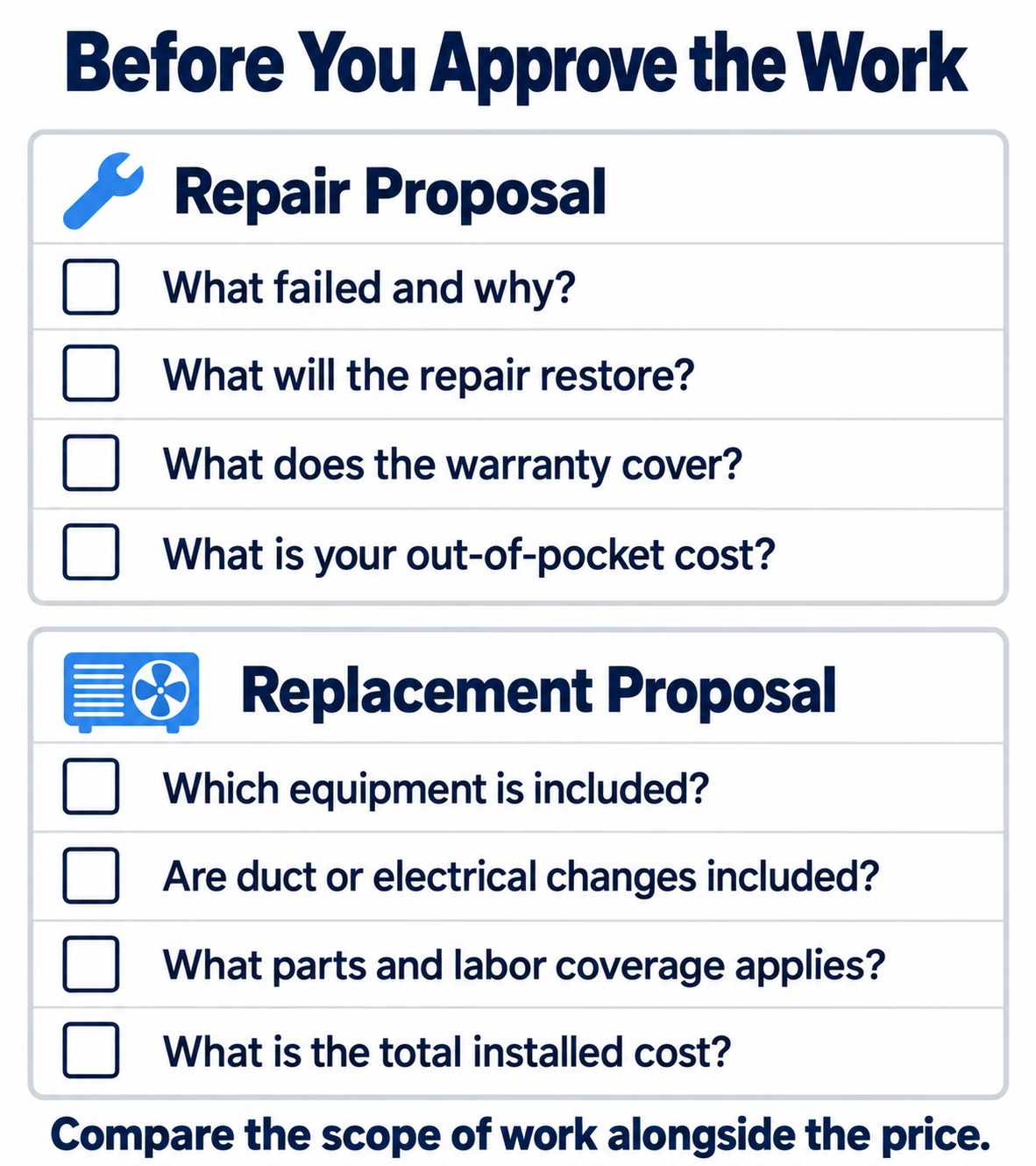
Written proposals provide a more useful comparison:
- Repair cost: The amount you would pay after applicable warranty coverage.
- Replacement scope: The equipment included and any necessary duct, electrical, or other installation work.
- Coverage: Parts and labor protection for each option.
- Operating costs: Estimated energy use based on the proposed equipment and your home.
The scope matters as much as the total. Replacing an air conditioner is a different project from replacing a furnace and AC together or converting the home to a heat pump.
Is a Heat Pump the Right Replacement for Your Eugene Home?
Replacing your heating system is an opportunity to consider how you want to heat and cool your Eugene home. A heat pump handles both jobs, making it worth comparing with a new furnace—especially if your home does not already have air conditioning. The right fit depends on your existing equipment, ductwork, and energy costs.
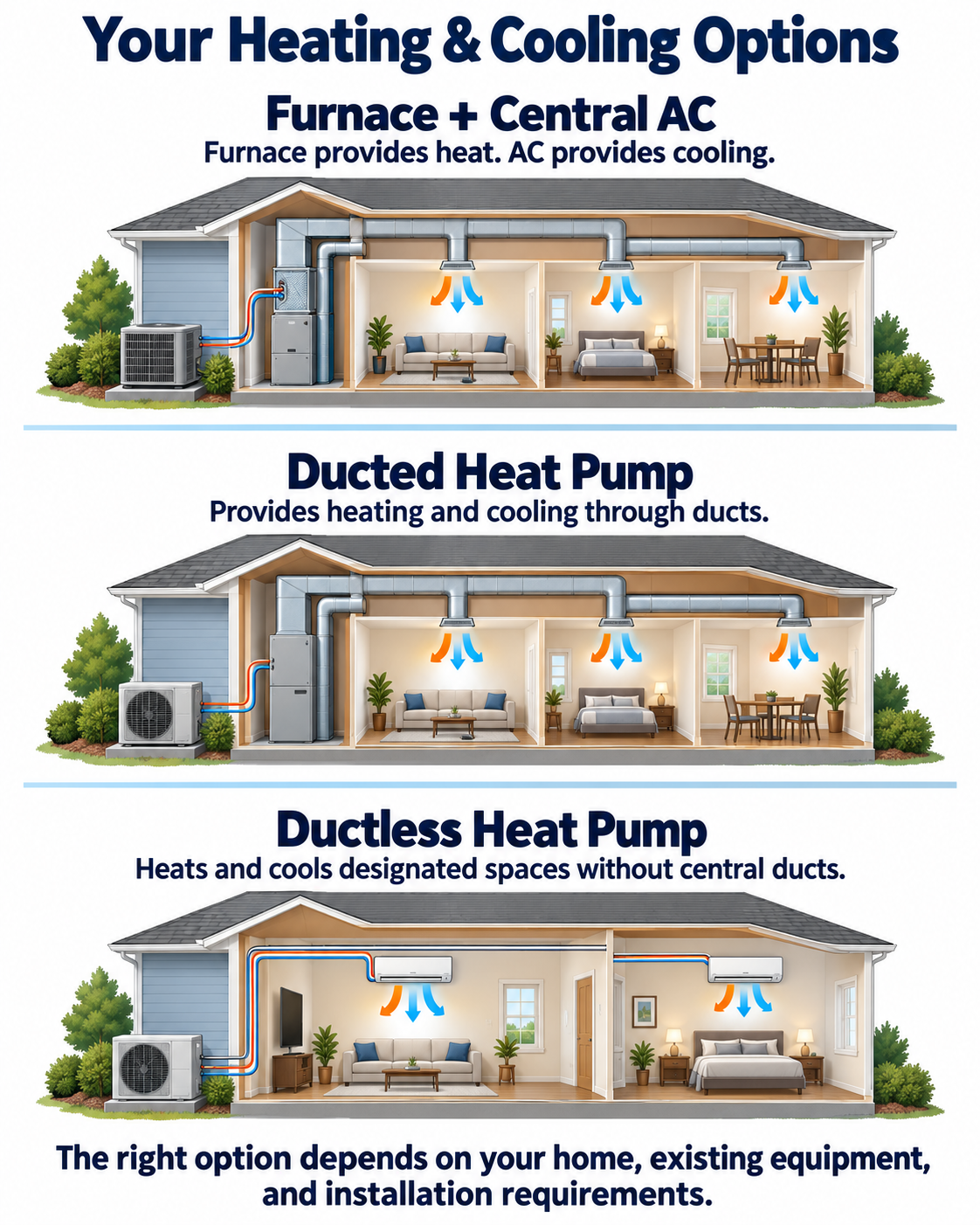
The replacement options differ depending on the system already serving your home:
- An existing heat pump: Replacement involves the heating and cooling system together. The indoor equipment, outdoor unit, and controls need to be compatible, and the proposal should identify which components are included.
- A gas furnace: A new furnace continues to provide heating, while a heat pump can provide heating and cooling. Installation requirements and local electricity and gas costs affect the financial comparison.
- Electric resistance heating: A heat pump moves heat rather than generating it through electric resistance. The potential change in energy use depends on the existing heating equipment, the proposed system, and how the home is conditioned.
For homes without ducts, ductless heat pumps can serve designated rooms or areas. The layout and placement of indoor units affect how well conditioned air reaches the spaces that need it.
Associated Heating & Air Conditioning provides heat pump installation, furnace replacement, and AC replacement for Eugene homeowners.
How Filtration Fits Into the Replacement Decision
During wildfire smoke events, indoor particle filtration becomes especially relevant for Eugene homes. Better filtration may be possible with existing equipment, so smoke concerns alone do not establish a need for HVAC replacement.
Central ducted systems can circulate air through a high-efficiency filter. EPA recommends MERV 13 filtration, or the highest efficiency the system can accommodate. Filter fit and airflow matter: gaps let air bypass the filter, while an overly restrictive filter can reduce airflow.
Ductless heat pumps provide heating and cooling, but their standard washable filters generally are not designed to capture fine smoke particles. A separate portable HEPA air cleaner can provide particle filtration in the rooms it serves.
When comparing replacement options, heating and cooling performance and smoke filtration are separate considerations. New equipment does not automatically provide better smoke protection; the filter and air-cleaning setup determine that capability.
Heat Pump Incentives for Eugene Homeowners
Program information checked October 27, 2026.
Local incentives can reduce the cost of a qualifying heat-pump installation, making replacement more affordable when it is already a sensible option for the home.
Eugene Water & Electric Board (EWEB) offers eligible electric customers:
- Ducted heat pumps: A standard $1,000 rebate per home.
- Ductless heat pumps: A standard $800 rebate per home.
Larger income-based rebates are available for qualifying households with electrically heated homes. EWEB also offers zero-interest loan options, subject to credit approval. Standard rebates and loans cannot be combined, although qualifying income-based programs allow both. Equipment and property requirements apply, and EWEB requires preapproval before installation is scheduled.
Full eligibility details are available through EWEB’s ducted heat-pump program and ductless heat-pump program. Homes served by other electric utilities may have different incentives.
Associated Heating & Air Conditioning also offers financing options. A rebate reduces the qualifying project’s cost; financing spreads payments over time. The interest rate, repayment period, and any fees determine how financing affects the total amount paid.
Frequently Asked Questions
Is It Worth Repairing a 15-Year-Old Furnace, AC, or Heat Pump?
It can be. A manageable repair on otherwise sound equipment may be worthwhile. Compare replacement when the repair is substantial, failures are recurring, or other components are deteriorating. Check warranty coverage before deciding.
Should I Replace My AC and Furnace Together?
Replacing both can make sense when both systems are aging or when the proposed equipment requires compatible components. However, a failed AC does not automatically mean a functioning furnace needs replacement. Separate and combined proposals show the additional cost of replacing both, making it easier to weigh that expense against equipment condition, installation requirements, and warranty coverage.
Will a New System Lower My Bills?
It depends on the existing equipment, the replacement’s efficiency, your home, and energy prices. Ask for estimated annual operating costs based on your current setup. Adding cooling also adds a service your previous heating-only system did not provide, so total bills may not fall.
What Happens to My Warranty If I Replace the Equipment?
The old equipment’s warranty generally does not cover a new replacement system. New equipment comes with its own warranty terms, which may depend on registration and other requirements. Manufacturer warranties often cover specified parts, while labor coverage may be provided separately by the contractor. Those differences affect what you would pay if the new system needs service.
Does Older Refrigerant Mean I Have to Replace My AC or Heat Pump?
No. Existing R-22 and R-410A systems can still be serviced, and refrigerant changes alone do not require replacement.
New R-22 production and imports have ended in the United States, so repairs depend on available supplies. A major refrigerant leak in an older R-22 system can make replacement more attractive, while a repair unrelated to refrigerant may still be worthwhile.
R-410A equipment also remains serviceable as newer systems transition to different refrigerants. The decision depends on the diagnosed problem, repair cost, and equipment condition.
Can I Wait Until the Heating or Cooling Season Is Over?
Waiting may be reasonable when the system remains safe to operate and delaying the repair is unlikely to cause additional damage. A system with an unresolved safety issue, a risk of further equipment damage, or an inability to maintain a safe indoor temperature needs more immediate attention. The diagnosis determines whether postponing the work is practical.
Get a Clear Answer: Repair or Replace?
An unexpected breakdown can leave you facing an expensive decision. Associated Heating & Air Conditioning helps Eugene homeowners understand what failed, what a repair would accomplish, and whether replacement offers better long-term value.
We’ve served the Eugene area since 1978, providing heating and cooling repairs and installations with upfront pricing and financing options available. Our team explains the recommended work and its cost before you commit.
Call (541) 215-4254 or request an appointment online to schedule your system evaluation.